
Why a Closed Bat Conservation Group Still Matters
The question behind this report
What happens to a conservation mission when the organization behind it is no longer operating?
That question is the reason I treat the Organization for Bat Conservation (OBC) as more than a closed institution with a fond following. OBC worked in public education from roughly the 1990s through the late 2010s before ceasing standalone operations, but its most useful legacy is not a scrapbook. It is a set of field lessons that homeowners, educators, nature centers, and volunteer leaders can still use.
I see three reader states again and again in bat outreach. People may love bats as an idea. They may still misunderstand roosting behavior when bats show up near a porch, chimney, barn, or attic. And many communities still lack enough safe roosting habitat near homes, gardens, water, and mature trees.
So this is an impact report in the practical sense. It looks at outcomes, habits, and stewardship choices that outlast a name on a program banner. For readers who need OBC’s formal corporate record, this article will not reconstruct that archive. For readers asking what remains useful, there is plenty to carry forward.
OBC’s Mission in Plain Language
Four pillars, one behavioral goal
OBC’s mission can be stated without ceremony: teach people about bats, explain why habitat matters, bring bat education into public spaces, and help humans coexist with bats more responsibly.
Those four working pillars were education, habitat awareness, public outreach, and human-bat coexistence. The audience was broad in the best community-education sense: families, K-12 schools, homeowners with existing roosts, nature centers, gardeners, and conservation volunteers.
The durable part was not simply telling people that bats are beneficial. Most audiences can absorb that in one sentence. The harder work starts when a homeowner finds guano below a soffit, a teacher wants to address rabies risk without feeding panic, or a gardener asks whether a bat house will solve an insect problem by itself.
That is where mission becomes behavior. Admiration is a start, but stewardship asks for a steadier hand.
Where the mission still feels current
The style of learning many people associate with places such as the Cranbrook Institute of Science still matters here: close observation, careful interpretation, and respect for wildlife boundaries. OBC’s strongest legacy sits in that space. It helped move bat education from “aren’t they interesting?” toward “what should I do next, and what should I not do?”

Education Outcomes: From Fear to Stewardship
What changed in the room
In our programs, the clearest signs of progress were often small. A child stopped calling bats creepy. A homeowner asked about timing before removing a roost. A volunteer wanted to know how to explain bat houses without promising instant occupancy.
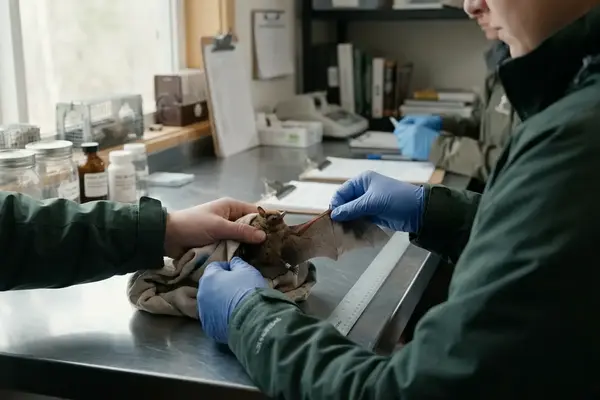
Those shifts matter because bat education has to reduce fear without creating unsafe confidence. Live ambassador programs, classroom visits, interpretive print materials, and community events made bats visible as pollinators, insect predators, and vulnerable wildlife rather than as pests. They also gave educators a chance to repeat one boundary clearly: the public should never handle bats directly because of rabies-exposure risk.
That safety message belongs beside every warm story about bats. The best education does not turn people into rescuers with bare hands. It turns them into calmer observers who know when to call a qualified local expert.
Better questions are an outcome
I would rather hear “Is this maternity season?” than “How do I get rid of them tonight?”
That change in question tells me the person has slowed down. They are thinking about young bats, seasonal timing, and legal or ethical limits. They may still need professional help, but they are less likely to make the problem worse.
For current guidance on safety and conservation basics, readers can also consult U.S. Fish & Wildlife Service bat conservation guidance.
Habitat Lessons That Outlast the Organization
Start with the roost you already have
The first habitat lesson is plain: protect existing roosts where it is safe to do so. A bat house can help in the right setting, but it should not become an excuse to remove mature trees, seal seasonal roosts carelessly, or treat bats as movable decorations.
Here is the field example I come back to. A homeowner mounts a bat house on a swaying tree trunk in deep shade. Two seasons pass with no occupancy. The conclusion is not that bats are absent from the area. The more likely lesson is that the siting failed.
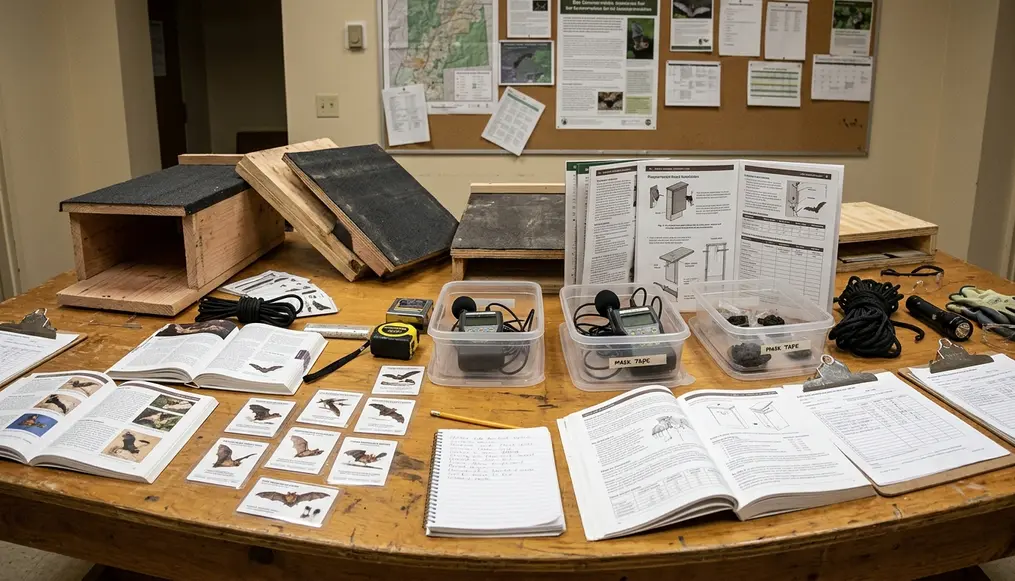
Bat houses need thoughtful placement. In cooler regions, warm sun exposure, often on south- or southeast-facing aspects, can matter. Mounting height commonly falls in the range of 12 to 20 feet above ground. Clearance from predator perches helps. A rigid installation on a pole or building usually serves bats better than a box swinging from a tree. Observation should happen from a distance.
Quick Tip: A bat house is habitat infrastructure, not decoration. Placement and patience matter more than novelty.
Seasonal timing is not one-size-fits-all
A northern installer’s safe inspection window and a southern installer’s can differ by weeks, so a single national “best time” rule can mislead. Maternity-season disturbance usually centers on late spring through mid-summer, while hibernation windows vary by latitude and species.
An attic colony found during maternity season cannot simply be excluded immediately without risking flightless pups trapped inside. That is where the responsible action diverges sharply from the instinct to “remove the roost.” Species composition and climate shift the details, so local wildlife agencies or bat conservation specialists should guide timing before anyone acts.
Resource Allocation: Where Conservation Effort Creates Value
A value summary, not a financial statement
This section is intentionally qualitative. No audited financials, donor totals, budget figures, or percentage breakdowns are provided in the source context for this report, so I am not going to invent them.
The more honest question is where conservation effort created mission value. For OBC-style public education, the main categories are clear: education materials, public programming, ambassador animal care where applicable, habitat guidance, volunteer coordination, and stewardship outreach.
Each category served a different kind of conservation need. Education materials helped a teacher or nature center keep the message alive after a visit. Public programming gave people a safe first encounter with bat biology. Habitat guidance translated concern into decisions about trees, water, pesticides, roost timing, and bat house placement. Volunteer coordination turned interest into repeated service.
Note: This report presents zero spend ratios. Readers needing audited numbers should seek official records elsewhere.
Why effort can matter without a dollar figure
Resource allocation is not only a budget exercise. In community conservation, it is also a question of attention. Do educators spend their limited time calming fear, correcting myths, preparing volunteers, or helping one homeowner avoid a harmful exclusion?
The answer changes by setting. A classroom needs wonder and safety. A homeowner needs timing, boundaries, and local referrals. A volunteer needs training sturdy enough to repeat without exaggeration.
Partnerships, Volunteers, and the Community Effect
Partnerships as delivery, not decoration
Partnerships mattered because bat education rarely stays inside one institution. Schools, nature centers, local conservation groups, wildlife educators, and community hosts helped carry the message into rooms OBC could not occupy every day.
That does not mean the presence of partners proves impact by itself. It means partnerships were a delivery mechanism. They made it possible for one program to shape a classroom lesson, a homeowner’s attic decision, a garden’s pesticide plan, or a volunteer’s multi-year involvement.
I think of volunteers as the hinge. They often begin with enthusiasm, then learn the harder parts: say “I don’t know” when needed, avoid handling wildlife, explain that bat houses are not guaranteed occupancy magnets, and point people toward local expertise when a roost conflict carries health or structural risk.
The community effect is cumulative
One informed person can interrupt a bad decision. One teacher can normalize bats as wildlife instead of Halloween props. One gardener can reduce pesticide use where feasible and protect the insects bats rely on. One homeowner can wait for the right season before addressing a roost.
None of those acts needs a parade. Together, they are how public education becomes stewardship.
Scope and Limitations of This Legacy Report
What this report does not claim
This section belongs here because the article touches several trust-sensitive areas: mission history, partnerships, public education outcomes, and resource allocation. On this specific question of carry-forward conservation practice, the strongest evidence is practical rather than archival.
BatRoost is not presenting a full audited institutional history, legal archive, or complete financial review of OBC. This report also does not use unverified attendance figures, donor totals, animal-care counts, program-volume statistics, partner counts, grant totals, or audience-size claims.
The retained scope is narrower and more useful for most readers: conservation lessons that homeowners, educators, and habitat stewards can carry forward now.
When local guidance should govern
Bat stewardship is local in the moments that matter most. Species, climate, building type, public-health rules, and seasonal timing can all change the right answer.
If this report and a local wildlife authority disagree on species-specific or seasonal guidance, follow the local authority. That is not a footnote to conservation. It is part of doing it well.
What the Legacy Asks of Bat Stewards Now
Turn admiration into careful action
The best parts of OBC’s mission ask for a certain kind of conservation temperament: curious, patient, non-invasive, and willing to learn before acting.
For readers ready to help, the next steps are practical:
- Learn before installing a bat house, especially about placement, mounting, sun exposure, and local species needs.
- Protect mature trees and nearby water sources where it is safe and feasible to do so.
- Reduce or avoid pesticides when possible, especially in gardens and landscapes meant to support wildlife.
- Observe bats without disturbance. Watch evening flight from a distance rather than approaching roost openings.
- Consult local experts when bats conflict with living spaces, chimneys, attics, or other structures.
A structural roost that creates a genuine health or safety conflict calls for exclusion handled by a qualified professional, not do-it-yourself observation. That is especially true during maternity season.
The work still in front of us
Legacy can become a soft word if we leave it in the past. Bat conservation needs something firmer.
It needs homeowners who ask better questions. Educators who balance wonder with safety. Volunteers who keep learning after the first exciting program. And it needs communities willing to support current, reputable bat conservation education through participation, sharing responsible habitat guidance, or donating where they trust the work.
The lesson I carry from OBC is simple enough to repeat: enthusiasm helps, but patience protects bats. Humility does too.
Summary: The Organization for Bat Conservation’s most useful legacy is not nostalgia. It is the habit of turning bat appreciation into careful habitat decisions, safe public education, and local stewardship that respects both people and wildlife.
Join the Conversation
No comments yet.
Join the Discussion