
The Night Shift in the Garden: A Pest Problem That Wasn’t So Simple
Chewed leaves, beetles, moths, and bats in the same frame
By morning, the leaves looked handled roughly. Some edges were notched. Other leaves had ragged holes through the middle. A few showed that thin, lacy skeletonizing that makes a gardener reach for the nearest answer too quickly.
By mid-morning, beetles were visible on stems. At dusk, moths gathered near the porch fixture. Roughly 20 to 35 minutes after local sunset, bats appeared overhead, cutting through the air above the yard while the garden owner stood still long enough to notice the sequence.
That timing mattered. The owner did not begin with a treatment decision. They began with a framing decision: was this a single-pest problem, or a symptom of a nighttime community they had not been watching?
The case came from a temperate North American backyard with ornamentals and vegetables, observed from mid-May into late June. That context is important because bat emergence shifts by region, season, elevation, and local weather. A northern yard and a southern yard can produce different dusk patterns even when the gardener follows the same routine.
BatRoost approaches these situations through habitat stewardship. The legacy of the Organization for Bat Conservation (OBC), including its public education work connected with the Cranbrook Institute of Science, is useful here because it pushed a basic conservation principle into everyday language: bats are wildlife, not pest-control devices. That distinction keeps expectations honest.
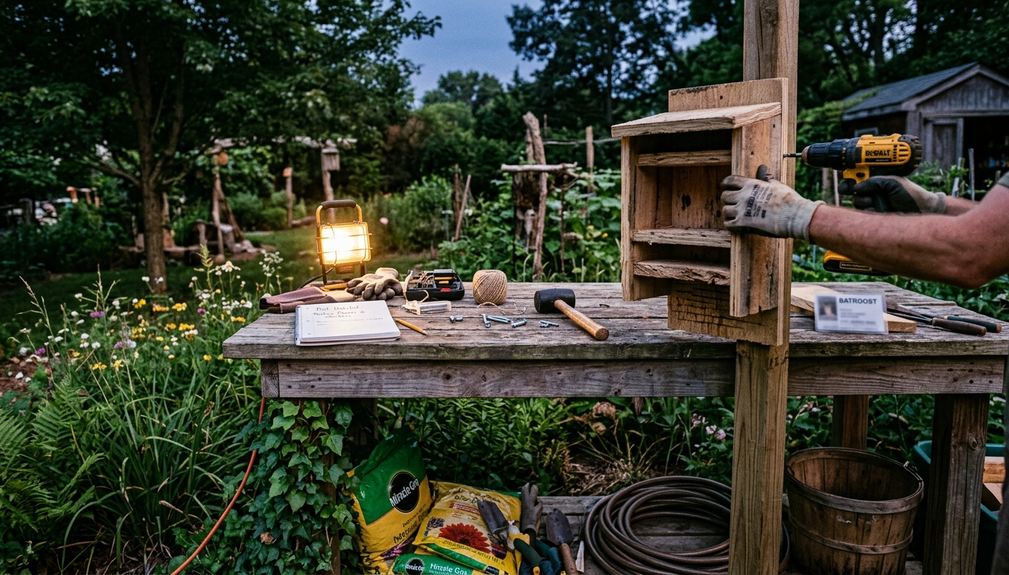
Challenge: Moths, Beetles, and the Temptation to Blame One Pest
Visible insects are not always the main actors
The easiest mistake was also the most tempting one: blame the beetles seen in daylight for every damaged leaf found at breakfast.
The owner separated three damage signatures instead of treating the garden as one blurred problem: irregular leaf-edge chewing, skeletonized interveinal tissue, and ragged holes mid-leaf. Adult moth activity near the porch light peaked in the first hour after dusk. Chewing damage was assessed each morning before 8 a.m., before heat, watering, and daily garden traffic muddied the picture.
That routine did not identify every insect. It did something more useful for decision-making: it slowed the jump from damage to pesticide.
Adult moths, caterpillars, adult beetles, beetle larvae, leaf-feeding sawfly larvae, and other herbivores can all sit near the same story without playing the same role. An adult moth near a light may not be chewing a tomato leaf. A beetle on a stem may be feeding, resting, mating, or simply visible when the actual larval feeding happened earlier.
Summary: Matching a damage pattern to a likely culprit is a working hypothesis, not an identification. Confident identification often requires catching the larva in the act or rearing it through its next stage.
This is where bats get oversold. A homeowner installs a bat house expecting fewer beetles within weeks, sees no change, and concludes bats “don’t work.” But the house may be empty, the beetles may not be on the bats’ menu, and the leaf damage may come from larvae feeding when no one is watching.
Field Notes Before Fixes: What the Backyard Steward Tracked
A repeatable routine beats memory
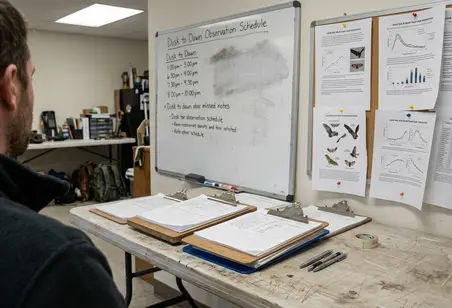
The steward set up a simple observation routine before changing lights, sprays, or structures. Not elaborate. Repeatable.
They used a fixed dusk window and a fixed morning window, then wrote down the same categories each time: date, clock time, sky and wind, which outdoor lights were on, plant species affected, visible insect activity, and bat activity overhead. Observations continued across a 10 to 14 night stretch on consecutive evenings so one warm, buggy night did not masquerade as a pattern.
In my programs, this is the point where people often relax. They realize they do not need to become taxonomists overnight. They need better notes than “bugs everywhere.”
What to record
- Date and approximate time of each observation.
- Weather conditions, especially wind, rain, and unusual temperature swings.
- Which outdoor lights were on, where they pointed, and when they were switched off.
- Plant species affected and whether damage was new or already present.
- Visible insects on stems, leaf undersides, flowers, soil surface, or near lights.
- Bat activity overhead, recorded only as presence or absence of visible foraging.
Casual backyard notes are not a scientific bat survey. They cannot establish population size, species identity, roost occupancy, or direct predation on a specific insect seen on a plant. Treat them as decision aids only.
Solution: Habitat Stewardship, Not Pest Eradication
Change the conditions before escalating the response
The central decision was to manage the yard as habitat rather than as a battlefield against one pest. Lighting came first because it was cheap, reversible, and already implicated by the notes: moths concentrated near the porch fixture at dusk.
The owner swapped one bright fixture for a warmer, downward-aimed light and left two non-essential lights off after 9 p.m. That did not make insects disappear. It reduced an artificial gathering point and made the yard less confusing as an observation site.
Outdoor lighting can concentrate moths in ways that make the garden look more infested than it is. It can also alter foraging space for bats and other nocturnal wildlife. The practical move is not total darkness at any cost; it is restraint. Aim fixtures downward. Use the least light needed for safety. Avoid bright lights near likely roosting routes, water sources, or open foraging paths.
Pesticide restraint as habitat practice
The next choice was pesticide restraint. Broad-spectrum applications may knock back beneficial insects, spider prey, and potential moth prey while missing the feeding stage responsible for the plant damage. That is the failure case I watch for: blaming daytime adult beetles for overnight skeletonizing, spraying broadly, and leaving the actual larval culprit feeding.
The better sequence is slower but cleaner: identify the likely plant-damage source, decide whether the damage threatens plant health, then use the least-disruptive plant-specific response available.
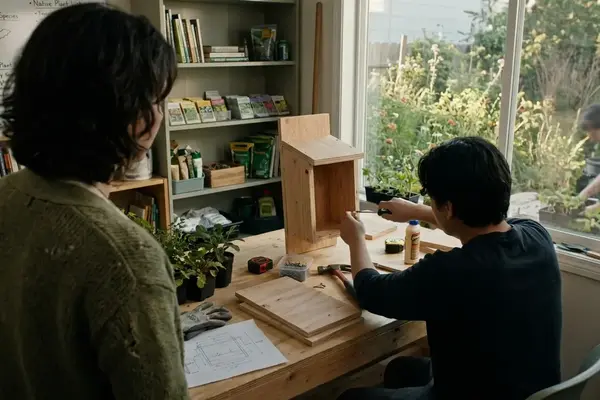
Quick Tip: If you add or evaluate a bat house, treat placement as habitat design. Common guidance used in this case placed the house 12 to 15 feet up, on a pole or structure with morning-to-midday sun, away from busy doorways and known predator perches.
One catch belongs in the same breath: a newly installed bat house may sit empty for one to several seasons, and occupancy is never guaranteed, even when placement looks sound.
What Bats Were Actually Doing in the Food Web
Aerial insectivores, not garden janitors
Many North American backyard bats are aerial insectivores. They take flying insects on the wing, including some moths and beetles when those insects are available in the airspace.
That sentence is intentionally modest. It does not assign a dramatic nightly insect count. It does not claim that the bats overhead ate the beetles on the stems or the larvae chewing leaves. It places bats where they belong in the food web: as predators whose influence depends on timing, prey availability, foraging routes, and habitat structure.
The U.S. Forest Service overview of bats and their ecological roles describes bats as important insect predators and pollinators in broader ecological systems. For this backyard case, the relevant point is narrow: bats can contribute predation pressure on flying insects, but they do not eliminate a pest group on command.
Bat presence overhead indicates foraging in the airspace. It does not confirm roost occupancy, species identity, or a direct meal built from the insects the gardener noticed on damaged plants.
Results: Better Decisions, Not a Pest-Free Garden
The measured outcome was restraint
The most honest result was not “fewer pests.” No verified pest counts existed, and the case was not designed to produce them.
The outcome was better decision quality across one growing season, from late spring through early autumn. The steward kept a routine of consecutive-evening observations, avoided two reactive broad-spectrum applications in favor of spot responses, made one lighting change, and completed periodic bat house checks.
Chewed leaves still appeared. Some were tolerated because the damage was cosmetic. Other plants received closer inspection because the damage pattern suggested ongoing stress rather than background feeding.
That distinction matters in a real garden. Cosmetic damage invites patience. Serious plant stress invites diagnosis. Panic invites broad treatment before the evidence is sorted.
Summary: A better-managed habitat is not a pest-free yard. It is a yard where observation changes the timing, scale, and selectivity of human action.
Scope and Limits: What This Case Cannot Prove
Boundaries keep conservation claims useful
One uncontrolled backyard case cannot isolate bats as the cause of any change in pest numbers. It cannot prove that bats reduced a specific moth, beetle, or larval population. It cannot turn visible bat activity into species identification.
That does not make the case useless. It makes the case practical. For backyard food-web decisions, the evidence stays local and suggestive, not conclusive.
A bat house is habitat, not a pest-control product. Marketing it as guaranteed pest suppression overstates what the evidence supports and sets homeowners up for disappointment.
Local rules also matter. Disease handling guidance, wildlife regulations, humane exclusion timing windows, and regional species differences vary by jurisdiction. When bats are inside a structure, grounded, sick, injured, or interacting with people or pets, the right next step is local professional guidance rather than improvisation.
A Backyard Food Web Checklist Inspired by the Case
Use the same sequence: observe, identify, adjust
The checklist follows the order that worked in the case: watch first, identify likely causes second, then change the cheapest reversible factors before investing in slower habitat structures.
- Observe before treating. Log dusk and morning conditions on consecutive evenings before changing anything.
- Photograph damage and activity. Use images across several evenings to detect patterns instead of relying on memory.
- Identify the likely plant-damage source. Compare edge chewing, skeletonizing, and mid-leaf holes, then inspect leaf undersides and stems.
- Reduce unnecessary outdoor lighting. Aim fixtures downward, use warmer light where appropriate, and turn off non-essential lights when safety allows.
- Avoid broad-spectrum pesticides when possible. Favor plant-specific, least-disruptive responses after the likely pest stage is identified.
- Protect water quality. Keep pesticide, fertilizer, and soil runoff away from drains, ponds, streams, and low spots where wildlife may drink or forage.
- Maintain diverse plantings. A layered garden with varied bloom times supports more insects, which in turn supports birds, spiders, bats, and other predators.
- Evaluate bat house placement carefully. Height, sun exposure, predator access, and human traffic all affect suitability, and occupancy may take time or never occur.
Note: Never handle grounded, sick, or injured bats. Contact local wildlife professionals or public health authorities when needed, since handling rules and rabies risk vary by area.
Educators, Volunteers, and Garden Groups
Turn the case into one concrete activity
For classrooms, garden clubs, and nature-center sessions, I would not start with a lecture on bat biology. I would start with a map.
Give the group one shared task: build a backyard food-web map linking plants, caterpillars, beetles, moths, bats, birds, spiders, outdoor lights, and human choices. A single meeting of roughly 45 to 60 minutes can carry that activity if the facilitator keeps the claims tight.
The value is visual. Participants see why “the beetles did it” may be too narrow. They also see why “add bats” is not a complete plan. Outdoor lighting, plant diversity, pesticide choice, and observation habits all sit on the same page.
Educators should avoid attaching impact numbers or partnership metrics that the source material does not support. Keep claims to ecological relationships, field observation, and decision-making. That restraint builds more trust than a polished but unsupported success story.
Closing: Invite Complexity Before Intervention
Tonight’s first step is watching
A silent, insect-free garden is not the goal. In a functioning food web, some insect activity is expected. Some leaves will show it.
The practical question is whether the damage calls for action, and if it does, what kind. A porch light attracting moths asks for a lighting decision. Skeletonized leaves ask for closer inspection. Bats overhead ask for humility about what can and cannot be inferred from a few minutes at dusk.
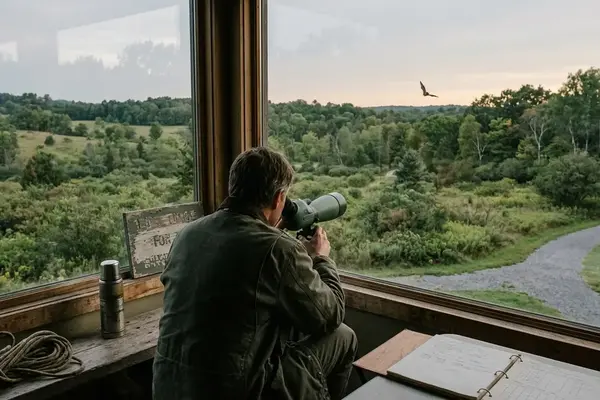
Before changing lighting, spraying plants, or adding a bat house, stand in the yard tonight near sunset. Watch what appears, what clusters, what flies, and what feeds. Then write it down.
That small habit is where better backyard conservation usually starts.



Join the Conversation
No comments yet.
Join the Discussion