
A Tree-Mounted Bat House Inherits the Tree’s Surroundings
A tree-mounted bat house attaches directly to a living trunk, making the tree’s canopy, branches, and ongoing growth a permanent part of the installation. By contrast, a pole installation supports the house on a freestanding metal or treated-timber post, allowing you to select its location, orientation, and clearance independently of any existing trunk.
This creates an immediate dilemma when you stand in a yard holding a new wooden box. The mature tree offers a ready-made vertical support right now, whereas sinking a post requires digging, concrete, and extra hardware. Yet the easiest attachment point available rarely gives you full control over daily sunlight, flight approach space, or long-term maintenance.
When I evaluate a potential roost site, I ask what the homeowner actually gets to decide. On a living tree, the clear stretch of trunk between the lowest limbs and the ground dictates your mounting height, facing direction, and entrance clearance. With a freestanding post, you lock in all three variables the moment you dig the hole. Community science materials from the Cranbrook Institute of Science and historical outreach by the Organization for Bat Conservation (OBC) have long prompted property owners to look closely at surrounding habitat before mounting a box, and that starts with understanding what your support structure forces you to accept.
Tree attachments usually rely on lag screws or through-bolts driven into the wood, often paired with spacer blocks behind the house. Wrapping wire or straps around a trunk constricts the tree as it adds girth every growing season, and expanding bark can eventually swallow fasteners whole. In temperate regions, attachment hardware is easiest to recheck when bats have left the house—commonly late autumn through early spring depending on region, and only after confirming the house is empty.
Compare the Roost Conditions, Not Just the Supports
Choosing between a trunk and a post means comparing the ecological and physical conditions each support creates. A pole by itself does not make occupancy more likely; the goal is selecting the support that delivers suitable, maintainable roost conditions at your specific property.
| Condition | Tree-mounted | Pole-mounted |
|---|---|---|
| Sunlight control | Constrained by the trunk's clear faces and overhead canopy development. | Chosen during siting; aspect and open sky exposure are set when placing the post. |
| Nearby vegetation | Subject to limb extension, seasonal leaf-out, and understory growth around the trunk. | Can be sited away from foliage, though surrounding plants still require periodic checks. |
| Climbing routes | Bark and connected branches provide natural paths from the ground and neighboring trees. | Smooth posts limit grip, though nearby fences, roofs, or shrubs can bridge the gap. |
| Structural upkeep | Requires off-season checks as trunk girth expands against lag screws, bolts, and spacers. | Requires checking post plumb, foundation stability, and mounting brackets over time. |
| Installation effort | Avoids excavation and foundation work; mounts directly to existing wood with hardware. | Requires utility locates, hole excavation, post setting, concrete curing, and heavy lifting. |
| Monitoring access | Viewing angles from the ground may be partially obscured by lower limbs and leaves. | Allows clear sightlines for dusk emergence watches if sited in an open area. |
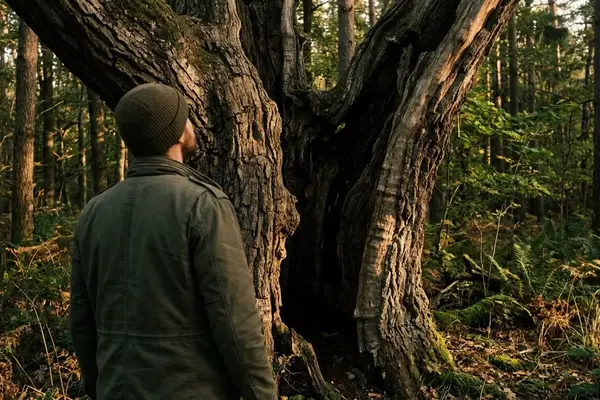
On a living tree, canopy development, branch arrangement, and annual trunk growth constrain where the box can sit and steadily alter the site after installation. A gap in the branches that lets morning light hit the trunk in year one can close over within a few growing seasons.
Freestanding poles give you siting flexibility in exchange for upfront labor and structural planning. Pole installations typically use a metal or treated-timber post set in a dug hole with concrete or a ground anchor. Most post-setting concrete mixes firm up within roughly 24 to 48 hours. Because manufacturer directions differ, mounting the house's weight should follow the product's stated cure time.
When comparing how different mounts perform across yards, remember that the support is only one variable among many confounders. Chamber width, number of chambers, exterior color, ventilation openings, the condition of the roughened landing area, distance to water and foraging habitat, and which bat species occur locally all shape whether bats move in.
Site Conditions Rule: Choose the support that gives suitable, maintainable roost conditions at your site. A pole by itself does not make occupancy more likely.
Canopy Shade Changes the Bat House’s Thermal Setting
Foliage filters solar radiation, meaning a tree trunk inspected in March looks completely different by July. In the temperate Northern Hemisphere, deciduous canopy is usually full from late spring to early autumn, which overlaps the main maternity period of roughly May through August. Judging a trunk before leaf-out makes a shady summer site look deceptively bright.
To get an accurate read on solar exposure, observe the exact proposed mounting position at three points in one day: mid-morning, early afternoon, and late afternoon. Repeat this schedule once leaves are fully out.
Pinpoint Sunlight Checks: Check sunlight at the precise spot where the house will hang. A sunny patch of lawn a few steps away can sit under very different shade from the trunk face or post top you are actually considering.
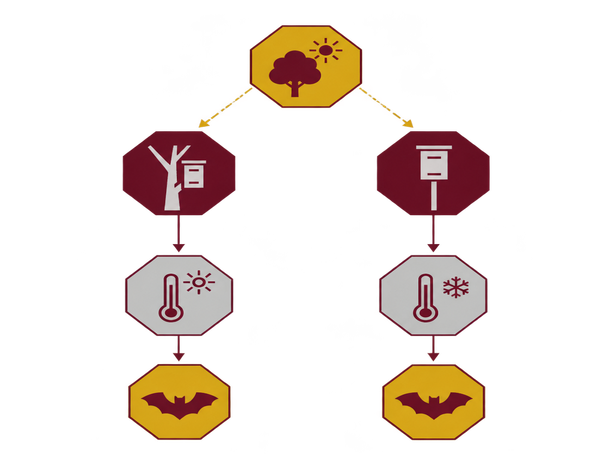
Solar exposure drives internal roost temperature, yet maximum sun is not universally desirable and shade is not automatically harmful. Thermal suitability depends on the interaction between regional climate, exterior house color, construction thickness, ventilation slots, and daily exposure. In regions with long, hot summers, the open exposure that helps a house warm up in a cool climate can push a dark, poorly ventilated house past what roosting bats tolerate. There, partial shade from a trunk or nearby canopy may be the better thermal setting, and an exposed pole site can be the riskier choice.
A post that clears the oak's limbs but receives unshaded afternoon sun on a dark, unvented house has swapped one disqualifying condition for another. Once both candidate sites fail the checklist, the tree-versus-pole question no longer applies, and the honest choice is to wait or find a different spot.
When I want to know how a placement actually behaves thermally, I separate visual shade estimates from internal heat data. An infrared thermometer pointed at the exterior reads only the outer surface. A small temperature logger placed in the chamber of a not-yet-occupied house for approximately 7 to 14 days of typical summer weather gives a far more useful picture, though short pre-occupancy logging windows still miss extreme late-summer heat waves. Never open an occupied house to take a reading.
Branches Affect Predator Routes and Bat Approach Space
Trunks and connected branches provide natural walkways for wildlife, while foliage growing close to the bottom entrance can clutter the airspace bats need as they drop out to take flight. Evaluating a mount requires looking at the structure both as a flight corridor and as a physical ladder.
Keep two separate concepts distinct during your inspection: a plausible access route versus documented predation. You can directly observe whether a limb touches the roof of a bat house, and no comparative field study is needed to see a physical bridge, whereas claiming that tree-mounted houses suffer higher predation rates would require comparative evidence not established here. Climbing animals that can use trunks, limbs, fences, or posts as routes include climbing snakes and raccoons. Domestic cats more often wait near the entrance at emergence than climb to the house.
Poles are also climbable if left unmodified or placed near jumping points. Placing a freestanding post next to a wooden fence, shed roof, or overhanging limb undermines its separation from climbing paths. Pole guards are typically cone-shaped or cylindrical baffles mounted on the post below the house. On trees, metal trunk bands must be loosened or replaced as the tree grows so they do not girdle the bark. No guard should sit near the open bottom entrance or leave loose mesh, netting, or wire where a bat could become entangled.
Judge entrance clearance from the ground during the leaf-on period and recheck it each year. Branches extend every growing season, and a clear flight path in one spring can be partly blocked two summers later.
Choose a Pole Site You Can Install and Maintain Safely
For example, a yard with heavily shaded trunks and crowded branches may offer a clearer flight path at a freestanding pole away from fences and overhanging limbs. If that spot receives harsh afternoon sun in a hot climate, however, a dark, unvented house still presents a thermal problem. The pole solves the branch-clearance problem, but that house and exposure remain an unsuitable pairing.
- Assess surrounding habitat: Check proximity to water sources, vegetated foraging corridors, and natural tree cover across the broader neighborhood.
- Evaluate solar exposure: Match the proposed spot's morning and afternoon sun against your regional summer climate, box color, and chamber ventilation.
- Check approach clearance: Confirm open drop space directly beneath the entrance and a clear flight path free of wires, branches, or walls.
- Assess nearby access routes: Ensure the post stands clear of fences, trellises, rooflines, and neighboring canopy limbs that climbers could use to bypass a baffle.
- Confirm safe installation and future inspection access: Verify you can dig safely, raise the weighted post without hazard, and view the entrance from the ground.
Weigh the practical costs qualitatively before committing. Mounting on a tree avoids buying and setting a post. A pole adds the post itself, a concrete foundation or ground anchor, mounting brackets, and digging labor, in exchange for letting you choose the exact aspect and separation from vegetation.
Before breaking ground for a pole, contact local utility-locate services; they generally require notice before digging, typically two to three business days depending on jurisdiction. Use that same planning window to confirm homeowner association rules, rental agreements, and local wildlife or building requirements. Match your fasteners and brackets to both the post material and the bat-house specifications.
Plan on installing during the off-season, before bats return in spring, to avoid disturbing active wildlife. If neither the trunk nor any open spot on your property passes the siting checklist, waiting a season or choosing another property location is preferable to forcing a weak placement.
Record Bat Activity Without Mistaking It for Proof
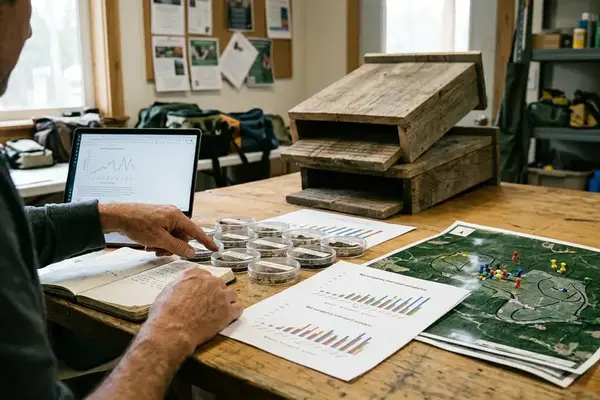
Once a house is up, structured observation tells you how the installation holds up and whether bats investigate it. A simple notebook or spreadsheet keeps backyard monitoring organized without disturbing the roost.
- Date and observation period: Record the exact date along with your start and end times.
- Weather conditions: Note ambient temperature, wind conditions, and any rain at dusk.
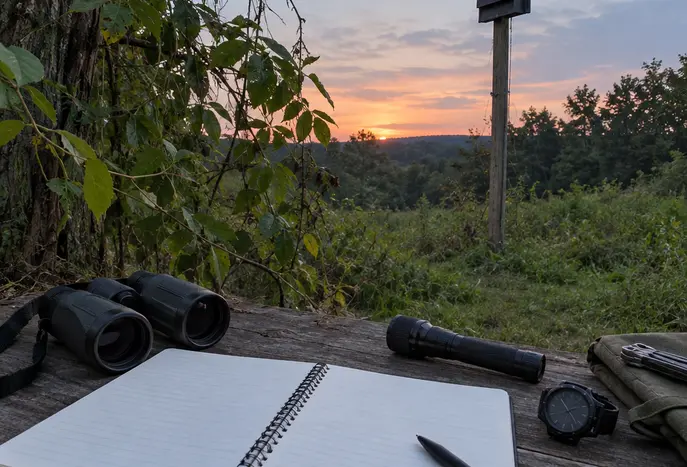
- Observation position: Use a consistent ground-level spot that gives a silhouette view of the bottom entrance against the evening sky.
- Visible emergence and signs: Count the number of bats seen emerging and check the ground below during the day for guano droppings.
- Vegetation changes: Log any new branch droop, vine growth, or leaf clutter encroaching on the drop zone.
- Installation condition: Check visually for loose mounting hardware, warped seams, or a tilting post.
Emergence watches usually run from about 15 minutes before sunset until 30 to 60 minutes after, or until light is too poor to count. Repeat watches over several weeks, because one empty evening does not show that a house is unused.
Break a single sighting under a pole-mounted house into its four possible claims: occupied once, reused across dates, used by a maternity colony, or contributing to conservation. Credit the mounting choice only with the claims the dated log can actually support. Seeing a bat drop from the entrance establishes occupancy on that date. Seeing bats across multiple weeks or returning the following spring shows repeated use. Observing a mid-to-late summer rise in emergence counts as young begin flying points toward reproductive use. A wider conservation benefit to local populations is something a single backyard log cannot demonstrate on its own.
Similarly, having one occupied pole house and one empty tree-mounted house in the same yard cannot isolate mounting type as the cause. Microclimate variations, box construction details, and random colony discovery confound two-house comparisons.
Hands Off Occupied Roosts: Do not open, move, seal, or repair a house that may be occupied. Contact a local wildlife agency or qualified bat professional first, because bats and their roosts are legally protected in many areas.
A Worked Choice Between a Shaded Trunk and an Open Pole Site
To see how this decision plays out step by step, consider a hypothetical case you can copy in your own yard. Imagine you have a new, unoccupied bat house and two candidate positions on the same property: the trunk of a mature oak with overhanging branches, or an open patch of lawn near the garden perimeter.
Step 1: Log Full-Leaf Shade Across the Day
Wait until the deciduous leaves are fully out in late spring, then visit both candidate spots at mid-morning, early afternoon, and late afternoon. Instead of guessing sunlight-hour totals, write down plain descriptions or sketch the shadows across the exact mounting height. In this yard, your notes show the oak trunk sits under heavy canopy shade during all three checks, while the open garden spot catches direct morning and early afternoon sun before catching light shade from a distant building late in the day.
Step 2: Trace Branch Connections and Flight Clearance
Walk around the oak and look up along the trunk face. You spot two thick lower limbs angling directly below where the entrance slot would hang, plus an upper branch touching the garage roof—creating both a cluttered flight drop zone and a continuous bridge for climbing animals. Walking over to the open garden spot, you confirm the ground and airspace are clear in all directions, with no fences, sheds, or overhanging limbs within climbing or jumping reach of where the post will stand.
Step 3: Match Exposure to Climate and Box Design
Compare the open garden site’s sunny log against your regional summer weather and the box in your hands. Because this hypothetical yard sits in a moderate climate and the house is painted a medium tone with side ventilation slots, the open exposure will warm the chambers without afternoon overheating. If you were working in a region with severe summer heat and holding a dark, unvented box, you would adjust the post position to catch late-afternoon shade before digging.
Step 4: Clear Utilities and Set the Post
With the open pole site selected, contact your local utility-locate service and wait the required two to three business days for underground lines to be marked. Dig the hole in the cleared garden spot, set the post in concrete, and let the foundation cure for the full 24 to 48 hours stated on the mix bag before bolting the bat house and a smooth predator baffle into place.
Step 5: Establish a Fixed Dusk Viewing Spot
In this yard, a spot across the lawn gives an unobstructed ground-level angle that silhouettes the bottom entrance against the western sky. Your observation log marks that viewing spot, where emergence watches begin about 15 minutes before sunset once warm summer evenings arrive.


Join the Conversation
No comments yet.
Join the Discussion