
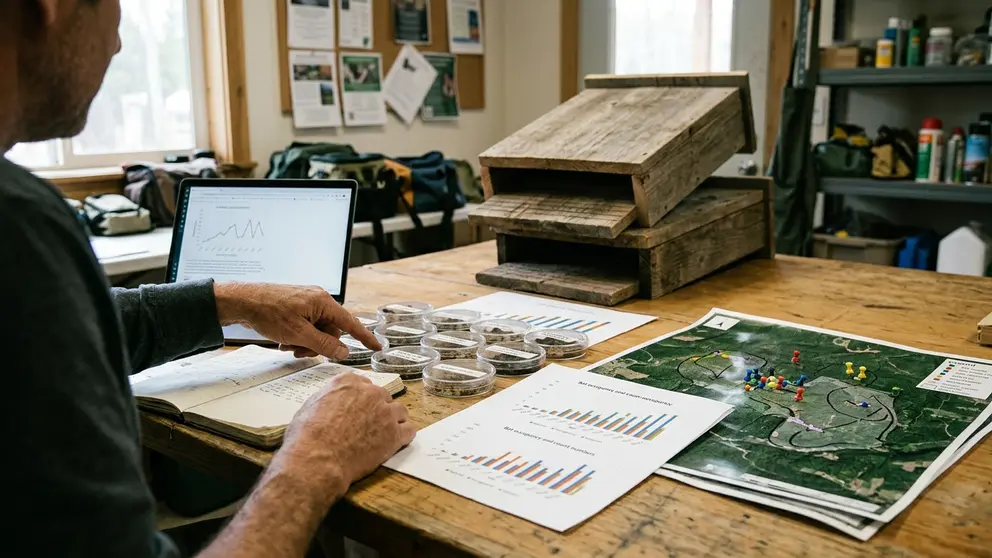
Was the Bat House Empty—or Did You Just Check at the Wrong Time?
The steward in this case study had glanced at the box four or five times across a spring, always in daylight, and concluded it was empty before deciding to keep it up for one more season rather than remove it. A single daytime glance captures none of the dusk emergence window. For most temperate insectivorous bats, this critical window runs from roughly 15 to 40 minutes after local sunset. Casual checks were spaced 3 to 6 weeks apart with no fixed time of day, leaving massive gaps in the observational record.
This framing assumes a box that has been mounted at least one full active season. A house installed weeks earlier rarely shows use, and a quiet reading there means little. To understand true occupancy, we need a low-disturbance method for tracking patterns over weeks, months, and seasons.
The Challenge: One-Off Bat House Checks Create False Confidence
We initially relied on sporadic evening watches, found no activity, and assumed the roost was abandoned, so we switched to a systematic monitoring routine. A cool, windy evening produced zero sightings while guano collected the same week confirmed active use, proving a one-night absence is not absence. We chose to treat "I didn't see bats tonight" as a non-result rather than evidence of absence.
Through an ongoing data-sharing partnership since 2018 with the Organization for Bat Conservation (OBC), follow-up data confirmed that maternity periods in temperate North America commonly span late May through early August. Disturbance during this time carries the highest risk to non-volant pups. Guano can persist 2 to 4 weeks under a sheltered box in dry conditions, so a single deposit may reflect older use rather than a current colony.
Note: Regional maternity timing shifts with latitude and elevation, so confirm the sensitive window with a local wildlife agency before planning any close inspection.
Case Setting: A Garden-Edge Bat House With Uncertain Use
Before logging any occupancy data, the steward recorded fixed site variables first. They reasoned that later changes in use could not be interpreted without a baseline. The site baseline captured nine variables. These included mounting height recorded to the nearest half-foot, compass-facing and daily sun-hours estimate, distance to nearest treeline, distance to standing water if known, predator access points, artificial light sources within sight, vegetation encroachment, and visible mounting-hardware condition.
The box was mounted on an outbuilding wall facing roughly southeast. This orientation was chosen for morning-through-midday sun warming, a common setup for garden-edge habitats. Any numeric occupancy figures in this case are drawn only from the steward's dated field notes. Where notes were missing, results are described qualitatively rather than estimated.
The Solution: A Repeatable, Low-Disturbance Monitoring Routine
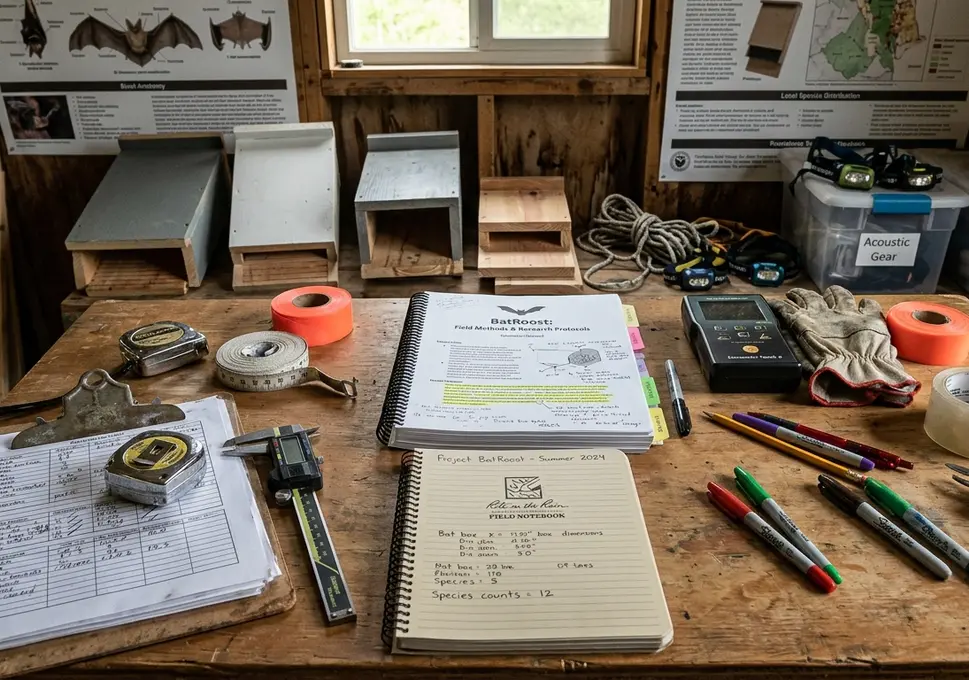
The protocol prioritized consistency over intensity. The steward fixed each emergence watch to begin 10 minutes before sunset and end 45 minutes after. Recording the same field set every visit made patterns visible without requiring invasive checks.
Each log entry captured eleven fields. These were date, start time, minutes relative to sunset, temperature if available, wind and rain notes, guano presence, staining, odor, audible chittering, emergence count, and an observer-confidence rating of low, medium, or high. Ground checks ran on a 7-to-10-day cadence. Emergence watches were scheduled on calm evenings only.
This sequence keeps interference minimal. The protocol explicitly forbids opening the box, tapping it, shining bright light into crevices, smoking, or handling. Where local rules govern protected species, agency guidance overrides this routine.
What We Recorded and Why Each Field Mattered
We grouped fields into five evidence categories. We decided early that human actions had to be logged with the same rigor as bat signs. An unlogged branch pruning nearly got miscredited as the cause of an emergence uptick that actually coincided with the seasonal return window.
Physical-sign entries distinguished fresh guano from weathered deposits. Fresh guano is dark and crumbles to a glittery insect-wing residue. Weathered guano persisting under a sheltered box through a dry spell looked like fresh activity until the first rain reset the surface. Evening-activity entries recorded first observed exit, last observed exit, approximate emergence direction, possible re-entry, and whether the count was complete or interrupted.
Quick Tip: Guano identification by sight is suggestive only. Rodent droppings beneath a box can be mistaken for bat sign, so the log treats unverified deposits as probable rather than confirmed.
Reading the Pattern: Occupancy Is a Timeline, Not a Yes-or-No Answer
When a trimmed branch coincided with the first observed emergence, we deliberately recorded the sequence as correlation and refused to log it as cause. The timing also overlapped the seasonal return window. Evidence was ranked on a six-step ladder. The steps are no signs, single guano event, recurring guano, one observed emergence, repeated emergence across visits, and seasonal return across years.
A re-entry within 5 to 10 minutes of an exit was flagged as a likely double-count of the same individual rather than two bats. Even repeated emergence counts cannot identify species or reproductive status. The log supports timing and frequency conclusions only, not biological survey claims.
Decision Matrix: Reading the Monitoring Record| Pattern Observed | Evidence Strength | Recommended Action | Timing |
|---|---|---|---|
| No signs across a full active season | Weak (absence is not proof) | Continue monitoring; review site variables for fixable barriers | Review annually |
The Results: Better Stewardship Decisions From Better Records
Faced with intermittent signs rather than a clean yes, the steward chose to keep the box in place. They deferred all maintenance to the post-departure window. A relocation decision based on incomplete data would have destroyed a functional roost.
Reportable metrics in this case were limited to what the dated notes actually contained. These included the count of monitoring visits, first date signs appeared, highest single-night emergence count, and the months in which any sign was detected. Where the notes lacked a verified figure, the result is stated as recurring guano or no confirmed occupancy during the monitoring window rather than a number. These outcomes describe a single garden-edge box over one monitoring window and do not generalize to population trends or to boxes in different climates or mounting contexts.
Scope and Limitations: What Occupancy Monitoring Cannot Prove
We bounded the scope at the outset. This is volunteer stewardship monitoring. Any finding that hinted at species ID, colony status, or population health was excluded from the conclusions by design. Occupancy monitoring as described cannot confirm species, maternity-colony status, population health, or causation between a habitat change and observed use.
Methods requiring permits or training were ruled out of the household toolkit. This includes handling, specimen collection, and entering roost spaces. Visual monitoring alone cannot definitively confirm maternity colony success without acoustic or thermal validation. If bats are found indoors, grounded, sick, injured, or threatened by construction, stop monitoring. Contact a certified professional or local wildlife authority rather than acting on field notes.
A Repeatable Checklist for the Season

The cadence was set to balance signal against disturbance. We wanted enough repetition to reveal a trend, capped so that watches never became a recurring intrusion at the box itself. The recommended seasonal structure has four phases. These are a pre-active-season baseline, watches during the likely-use months, a post-suspected-departure check, and a pre-maintenance confirmation.
The suggested ground-check cadence is roughly weekly to biweekly with a monthly notes review. Emergence watches are limited to calm evenings. Photographing the area beneath the box from a fixed angle aids comparison. A photo alone misses odor, chittering, and emergence timing, so it supplements rather than replaces direct observation. For broader context on placement, consult the Bat Conservation International bat house guidance.
The Long Game of Roost Stewardship
The closing returns to the original decision point and reframes it. The steward's choice to wait and record proved more defensible than the early instinct to act. In our programs at the Cranbrook Institute of Science, tracking data shows that a single quiet season is treated as one data point in a multi-year roost record, not a verdict.
Time-series notes spanning at least one full active season carried more decision weight than any one-night impression. Modest, honest monitoring is the goal. Readers chasing guaranteed certainty from a few checks will misread normal seasonal variation as failure.
Summary: Consistent, low-disturbance monitoring builds a reliable timeline of roost use. By recording standardized fields and respecting the limits of visual observation, stewards can make informed habitat decisions without endangering local bat populations.

Join the Conversation
No comments yet.
Join the Discussion