
Abstract
Bat decline is rarely attributable to one isolated pressure. Instead, population risk is produced by overlapping threats acting across roosting, feeding, migration, and hibernation periods. When we look at colony losses, single-threat framings repeatedly fail to explain the full picture. Eight primary threat categories drive the current conservation reality: habitat loss, roost disturbance, disease, climate stress, pesticides, prey decline, energy infrastructure, and human conflict.
This article synthesizes these pressures for homeowners, educators, gardeners, conservation volunteers, and habitat stewards. It is not a new statistical meta-analysis. Rather, it translates ecological data into a practical framework, helping you make informed choices about roost habitat and community education.
Methodology
To build this framework, I conducted a qualitative evidence synthesis. The source material spans peer-reviewed ecological literature and conservation agency resources published across roughly the past 10 to 15 years. Specific evidence types included species status assessments, roost ecology findings, white-nose syndrome documentation, land-use studies, wind energy mortality research, and best-practice habitat guidance.
Evidence selection proceeded by first defining strict inclusion logic—a threat had to plausibly affect roost availability, survival, reproduction, hibernation energetics, prey access, or human tolerance. Because this is a qualitative synthesis, it cannot weight one threat as quantitatively dominant; a reader needing region-specific severity ordering should consult local species recovery plans instead.
Key Findings
Before diving into the mechanics of each threat, it helps to establish a baseline. The strongest conservation interpretation is cumulative risk, not single-cause decline. Bats are exceptionally vulnerable to overlapping pressures because many species rely on highly specific roost structures and face severe seasonal energy bottlenecks.
Furthermore, many temperate bats produce only one pup per year. This reproductive rate is far slower than comparably sized rodents, which drastically lengthens population recovery timelines after a die-off. To structure our evidence-to-action framework, I separated the threats into three functional categories:
- Loss of safe places: Destruction or degradation of roosting and hibernation sites.
- Increased mortality or physiological stress: Direct fatalities from disease, infrastructure, or extreme weather.
- Degradation of landscapes: Reductions in insect prey and foraging habitat quality.
Habitat Loss and Roost Disturbance
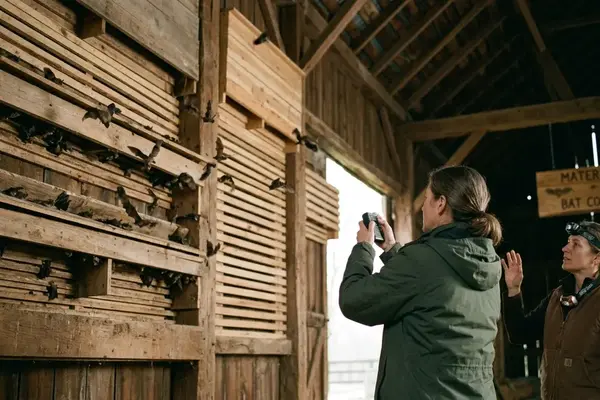
Roost habitat is the central pillar of bat survival. Bats depend on tree cavities, loose bark, caves, mines, bridges, buildings, and rock crevices for shelter, maternity colonies, and hibernation. We must separate habitat destruction from disturbance because the stewardship responses differ entirely. Destruction calls for preserving structures and timing of work. Disturbance calls for limiting access.
Mechanisms of habitat loss include forest clearing, removal of dead or aging trees, cave gating without bat-compatible design, mine closures, bridge repairs, and building demolition. Poorly timed exclusions from human structures are a particularly severe threat. Exclusions should generally avoid the maternity period, which in many temperate regions falls roughly across late spring through midsummer when pups are non-volant.
An exclusion sealed during the non-volant maternity period can trap flightless pups inside a wall, converting a routine repair into a colony die-off.
Disturbance, on the other hand, involves repeated cave entry, bright lighting, noise, heat changes, and handling. These actions disrupt resting, maternity, or hibernation behavior without necessarily destroying the physical space. Protecting existing natural roosts generally outperforms installing a bat house alone, but this holds only where a natural roost is actually present and viable. Treat bat houses as supplemental habitat. A new box does not compensate for losing a long-established maternity colony site.
Disease Pressure: White-Nose Syndrome and Health Stress
Conservation Implications

White-nose syndrome remains a major disease threat associated with the fungus Pseudogymnoascus destructans. It primarily affects hibernating bats in affected regions. Early in my career, I made the decision to describe this disease mechanistically rather than quantitatively, focusing on how it alters bat physiology rather than citing regional mortality percentages.
The documented mechanisms are devastating. Infected bats experience disrupted hibernation arousal, premature depletion of fat reserves, wing membrane damage, and reduced overwinter survival across the hibernation season, which runs roughly from late autumn through early spring. The fungus thrives in the cold, damp environments of caves and mines.
Note: White-nose syndrome devastates cave-hibernating species while leaving non-hibernating tree-roosting bats in the same area largely untouched by that specific threat. Disease impact is heavily concentrated among those species that rely on deep, stable underground microclimates to survive the winter.
Climate Stress, Water Availability, and Roost Temperature
When evaluating climate-related pressures, I deliberately frame the discussion around the distinction between mitigation and adaptation. Local stewards cannot influence broad climate trends, so guidance must steer toward reducing avoidable thermal stress at the roost level. Heat waves, drought, altered insect emergence, wildfire, and extreme storms all affect roost suitability and foraging success.
Roost temperature matters immensely. Maternity colonies and non-volant pups are especially sensitive to overheating during summer heat events and to cold snaps during the spring roosting period. Placement factors for artificial roosts become critical decision points: sun exposure, ventilation, mounting height, predator access, and regional climate all dictate success.
A bat house orientation that keeps a colony comfortable in a cool northern climate can lethally overheat the same box in a hot southern region. Placement advice does not transfer across regions without adjustment. Water access is also a vital habitat quality issue. Landscapes where wetlands, ponds, streams, or night-flying insect habitat have been reduced force bats to expend more energy commuting to drink, compounding thermal stress.
Pesticides, Contaminants, and Insect Prey Decline
Pesticides act primarily as an indirect pathway, operating through the prey base rather than as a direct poisoning narrative. Many bats rely heavily on insects. Declines or seasonal mismatches in prey availability directly reduce foraging success. Exposure pathways include contaminated insect prey, water sources, and roost environments.
Risk varies heavily by chemical, dose, species, and landscape. Bioaccumulation and sublethal stress can weaken bats, making them more susceptible to other pressures like disease or migration fatigue. Stewardship actions should emphasize integrated pest management, native nocturnal-insect-supporting plantings, and the protection of riparian corridors.
Quick Tip: Reducing garden pesticide use supports the broader nocturnal food web. However, it should be framed as conservation-adjacent, not as a guaranteed driver of local bat population recovery.
Energy Infrastructure, Built Environments, and Human Conflict
Direct mortality and displacement stem from wind energy facilities, roads, building renovations, and artificial lighting. We pair each mortality risk with a known mitigation lever—siting, timing, operational adjustment, lighting design, or professional consultation.
Wind turbine risk is highly species- and site-specific. Migratory tree-roosting bats are often discussed in the literature as a primary concern. Wind-related bat fatalities cluster heavily in the late-summer to autumn migration window, when operational curtailment is most often discussed as a mitigation strategy.
Artificial light acts as a severe behavioral stressor. It alters insect distribution, commuting routes, roost emergence, and predator exposure depending on the context. Lighting and curtailment fixes reduce impact at the affected site only; they do nothing for colonies displaced by habitat conversion elsewhere along a migratory route.

Translating these threat categories into a prioritized action sequence is the core of applied stewardship. The sequence is clear: protect existing roosts, avoid disturbance, maintain insect-rich habitat, reduce chemical pressure, preserve water, and then use bat houses as a supplemental measure.
If you are managing a property, your decision checklist anchors on four questions:
- Is there an active roost?
- Is it maternity season?
- Is exclusion truly necessary?
- Are safer habitat improvements available first?
This guidance continues an educational conservation tradition championed by groups like the Organization for Bat Conservation (OBC), converting scientific risk categories into public-facing stewardship steps. Homeowner-level actions are genuinely supportive but cannot replace protected habitat, responsible infrastructure planning, disease surveillance, or formal species recovery programs.
Limitations
It is important to explicitly restate what this article is not. It is not original field research, a population model, or a global numerical threat ranking. Threat severity is explicitly conditioned on species, region, season, roost type, land-use history, and disease presence.
Monitoring coverage remains uneven. Some species lack the long-term survey data needed for confident trend statements. Conclusions drawn for well-studied temperate hibernators should not be extrapolated to data-poor species without local verification. For formal, quantified risk evaluations, readers should consult IUCN Red List threat assessments and regional wildlife agency reports.
Summary:
Bat conservation requires a multi-faceted approach that acknowledges the cumulative nature of ecological threats. By protecting natural roosts, respecting maternity seasons, and mitigating thermal and chemical stress, local stewards can provide critical support to vulnerable populations.





Join the Conversation
No comments yet.
Join the Discussion